
Marketplace Seller-Protection (SPF) Claim Management Services in India
We review QC-failed returns and seller reimbursement claims, prepare and file eligible cases through authorized workflows, and match approved amounts to actual credits. Eligibility depends on channel policy, evidence, contract terms and filing windows.
The problem
Where claims stall
01
Returns fail QC and the claim is still open.
Returns that fail quality checks can be eligible for a claim, but only with the right warehouse evidence. Assembling that file and checking it against channel rules takes time.
02
Filing windows are set by each channel.
A claim must be validated and filed within the channel's time limit. Rejected cases need rework and escalation before they can move forward.
03
Tickets stall and credits go missing.
A filed case can sit open while the platform replies. Approved amounts still need to be matched to an actual credit, and that step is easy to miss.
What we handle
What we handle
- QC-failed returns, where the return was received and failed QC
- Damaged, wrong-item and missing-item disputes
- Eligible seller reimbursement claims
- Short-paid settlements and outstanding credits
- Ticket tracking, rework and reimbursement matching for filed cases
- Return Not in Hand cases, scoped separately because they need different evidence. See Return Not in Hand claims.
Channels
Amazon, Flipkart, Myntra, AJIO, Nykaa and Meesho, plus other supported marketplace setups. Amazon claims use seller reimbursement terms, with SAFE-T where applicable. Flipkart, Myntra, AJIO and Nykaa use Seller Protection Fund (SPF) terms. Meesho uses its own support-ticket claim process. We confirm the route for your account before filing.
Limits
Not every return or deduction is recoverable. Eligibility depends on channel policy, return reason, seller fulfilment model, evidence and filing window. Filing coverage depends on the seller account, claim type, platform process and permissions. Volume bands, burst handling and escalation are set in the service agreement.
How it works
From discrepancy to verified recovery
1
Connect
- Technology
- Ingests order, return, QC, invoice and settlement data from supported channel accounts.
- Managed team
- Agrees permissions, source-of-truth records (warehouse QC), SLAs and exception handling.
2
Reconcile
- Technology
- Matches returns to orders and settlements. Flags QC-failed returns and short-paid settlements as candidate claims.
- Managed team
- Confirms which exceptions are valid and worth filing.
3
Validate
- Technology
- Calculates the claim value and assembles QC notes, return label, photos, and item and order IDs.
- Managed team
- Checks eligibility, the filing window and the claim category against channel rules.
4
File and pursue
- Technology
- Organizes case files, ticket references and claim status where the platform supports it.
- Managed team
- Submits authorized claims, follows up with platform teams, reworks rejected cases and escalates.
5
Verify credit
- Technology
- Matches reimbursed amounts to payouts and settlement records.
- Managed team
- Closes the recovery ledger and reports approved, credited and unresolved cases as separate states.
Division of work
What ForceSight automates vs what your specialist handles
ForceSight automates
- Ingesting channel, order, return and settlement data
- Matching returns to warehouse QC records and settlements
- Flagging candidate claims and short payments
- Organizing case files, ticket references and claim status
- Matching approved reimbursements to credits
Your specialist handles
- Validating eligibility and the filing window for each case
- Submitting authorized claims and following up with platform teams
- Reworking rejected claims and escalating through the marketplace account manager
- Confirming approvals and exceptions with your team
Getting started
What we need from you
- Marketplace seller portal access and the platform permissions needed to file
- Order, return and warehouse receipt data
- QC notes, return label, product photographs, item and order IDs, and package images or unboxing footage where the channel requires them
- Invoices, credit notes, and settlement or payout reports
- Named approvers for claim submissions
- Agreed escalation contacts and evidence turnaround
Client approvals, evidence and portal access may still be needed for each case.
The CFO view
Recovery ledger
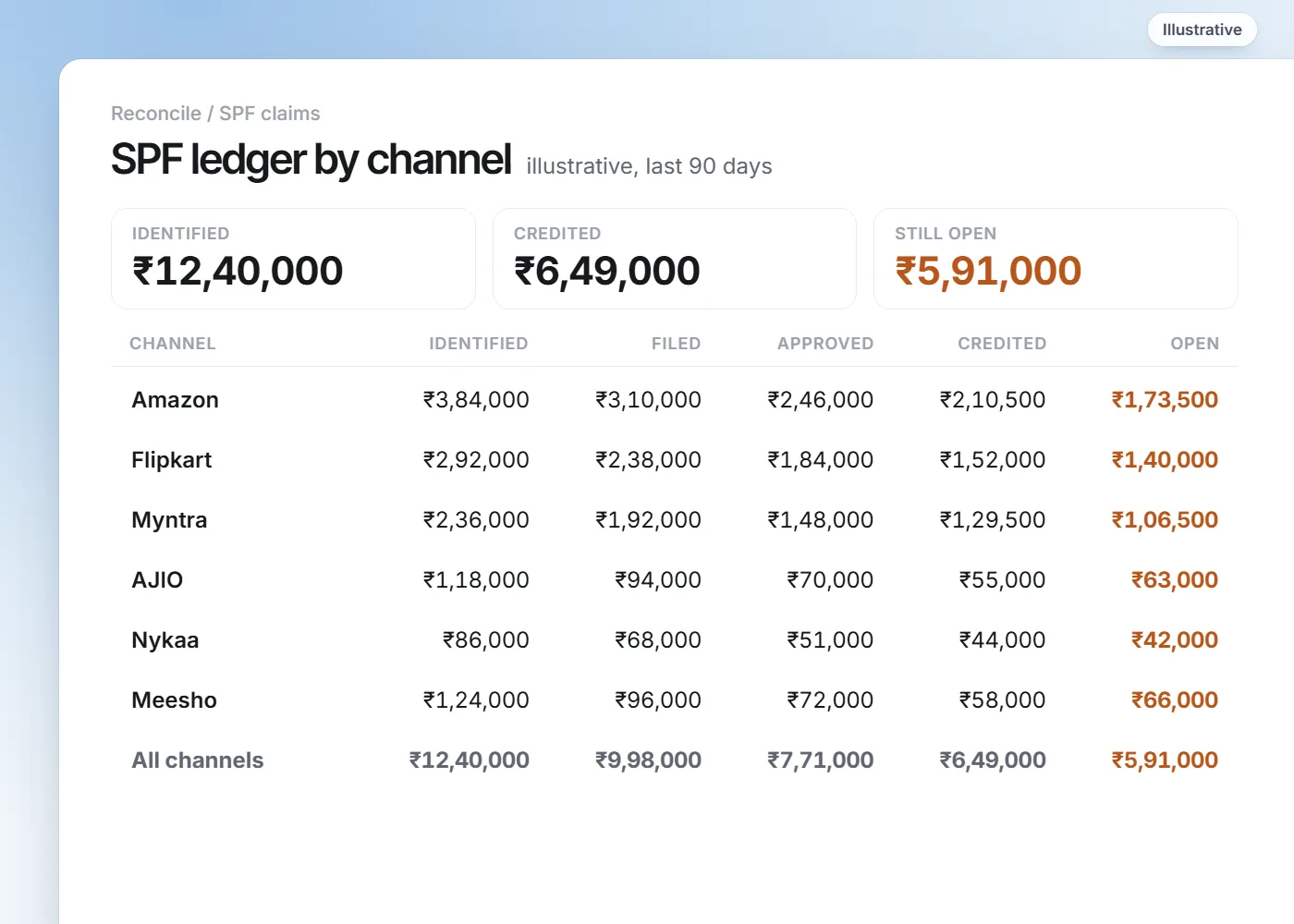
Example data. The ledger tracks each candidate SPF claim by channel, from identified and validated through filed, approved and credited. Approved and credited are shown as separate states, and claims closed without reimbursement are not counted as money recovered.
See the numbers as a table
| Channel | Identified | Filed | Approved | Credited | Open |
|---|---|---|---|---|---|
| Amazon | ₹3,84,000 | ₹3,10,000 | ₹2,46,000 | ₹2,10,500 | ₹1,73,500 |
| Flipkart | ₹2,92,000 | ₹2,38,000 | ₹1,84,000 | ₹1,52,000 | ₹1,40,000 |
| Myntra | ₹2,36,000 | ₹1,92,000 | ₹1,48,000 | ₹1,29,500 | ₹1,06,500 |
| AJIO | ₹1,18,000 | ₹94,000 | ₹70,000 | ₹55,000 | ₹63,000 |
| Nykaa | ₹86,000 | ₹68,000 | ₹51,000 | ₹44,000 | ₹42,000 |
| Meesho | ₹1,24,000 | ₹96,000 | ₹72,000 | ₹58,000 | ₹66,000 |
| All channels | ₹12,40,000 | ₹9,98,000 | ₹7,71,000 | ₹6,49,000 | ₹5,91,000 |
Approved and credited stay separate. Only credited money has reached a settlement or bank record. Example data, not customer recovery data.
FAQ
Frequently asked questions
Which QC-failed returns are potentially eligible for a claim?
Eligibility depends on channel policy, return reason, seller fulfilment model, evidence and filing window; the specialist validates case requirements before submission.
What evidence should our warehouse capture?
Typical requirements may include QC notes, return label, product photographs, item and order IDs, package images and unboxing footage where the channel requires it.
What happens if a marketplace rejects a filed claim?
The team reviews the rejection, collects any missing documentation, reworks eligible claims and escalates cases according to agreed rules.
How do you handle sale-event spikes in return volume?
The service agreement sets expected base volume, burst handling, claim deadlines and an escalation plan rather than assuming unlimited claims at a fixed fee.
Do you reconcile approved reimbursements with marketplace credits?
Yes, where settlement data is available and matching is included in the agreement. Approval, posted credit and bank settlement are reported separately.
Which marketplace channels can you cover?
We assess claim workflows across supported accounts on Amazon, Flipkart, Myntra, AJIO, Nykaa, Meesho and other applicable channels. Filing coverage depends on the specific seller account, claim type, platform process and permissions.
Can ForceSight file claims and follow up without my team?
For supported workflows and authorized accounts, we manage filing and follow-ups. Your team may still need to provide evidence, approve submissions, enable portal access or escalate through the marketplace account manager.
What is the difference between Return in Hand and Return Not in Hand?
Return in Hand means the warehouse physically received a return but it failed QC—for example, the wrong or damaged product arrived. Return Not in Hand means the expected return has not been received or its delivery status conflicts with warehouse records. These require different evidence and dispute workflows.
Managed reconciliation & claims recovery
Stop chasing claims. Let ForceSight take it from here
Schedule a CallShare your channel mix, monthly return volumes and current outstanding claims, and we will review where SPF claim management can reduce the workload on your finance team.