
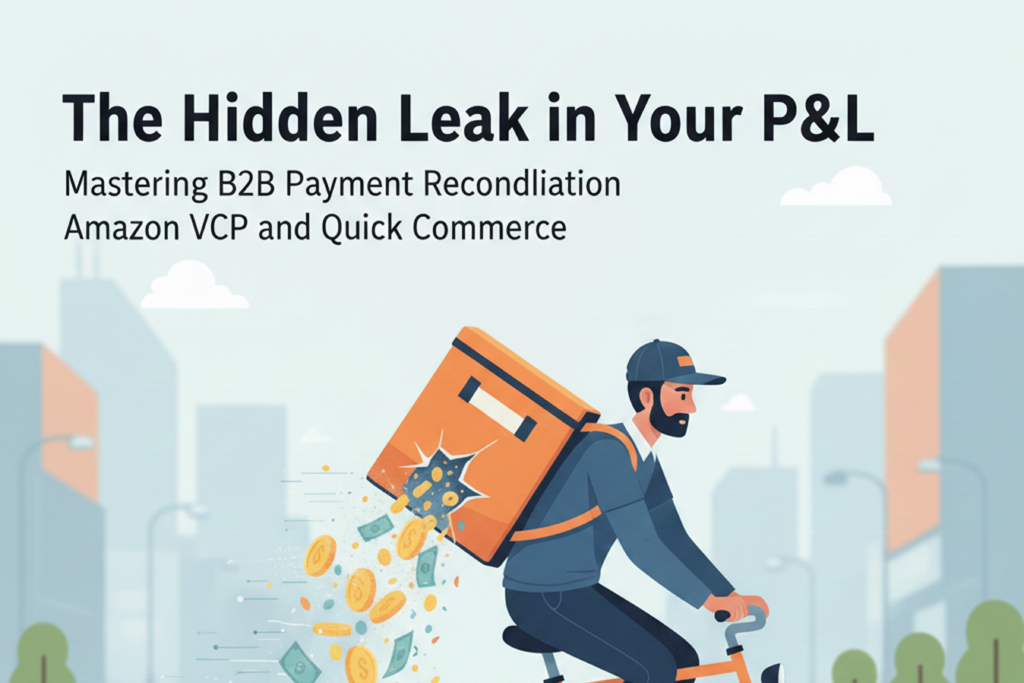
The Hidden Leak in Your P&L: Mastering B2B Payment Reconciliation for Amazon VCP and Quick Commerce
For consumer brands in India today, being present on platforms like Amazon VCP, Flipkart, and the exploding Quick Commerce sector (Swiggy Instamart, Zepto, Blinkit) is non-negotiable. The volume is high, and the velocity is thrilling. However, for Finance and Operations teams, this scale creates a massive blind spot. While the top-line revenue looks healthy, the journey from "PO Raised" to "Cash in Bank" is fraught with complexities that standard ERPs simply cannot handle. If you are managing 500+ invoices a month, you know the struggle: Reconciliation is not just backend paperwork; it is a profit-recovery mechanism.
The Two Worlds of B2B Reconciliation
To understand why money leaks, we have to look at the distinct operational mechanics of Marketplaces versus Quick Commerce.
1. The Amazon VCP & Flipkart Loop: The Cycle of Claims In the Amazon Vendor Central (VCP) ecosystem, the process is theoretically linear but practically chaotic. You receive a PO, fulfill the items, and upload the invoice. But the moment goods hit the Amazon warehouse, the variance game begins.
- Shortage Claims (SC): Due to capacity constraints, Amazon often GRNs (Goods Received Note) only partial quantities. The rest are marked as Shortage Claims.
- The Reversal Lag: These SCs are deducted from your payment advice instantly. While many are eventually found and reversed (SCR), this cycle takes 2–4 months.
- The Untagged Returns: Returns and damaged goods generate debit notes that often span multiple invoices and aren’t tagged to a specific transaction ID.
- Contra COGS: Marketing budgets and agreed discounts further complicate the ledger.
Without a robust tracking system, you cannot distinguish between a temporary Shortage Claim and a permanent loss that requires fighting with an Account Manager.
2. The Quick Commerce Maze: The SOR Trap Platforms like Zepto, Blinkit, and Swiggy Instamart operate differently. Here, the invoice is physically sent with the shipment, but payments are generally made on a Sale or Return (SOR) basis.
- The Trickle Effect: You don’t get paid for the invoice at once. Payments trickle in over multiple settlements as inventory moves.
- The Adjustment Avalanche: Your ledger is hit with Brand Funded Discounts (BFD), Return to Vendor (RTV), Liquidation costs, and TCS/TDS deductions.
- AP/AR Offsets: Platforms often offset your receivables against ad spends or liquidation fees.
The result? Payment reports provide big-picture numbers, but matching them to specific invoices to confirm "Paid in Full" status is nearly impossible manually.
The Challenge: Data Paralysis
For a brand scaling up, "ticking and tying" these details on Excel is a recipe for disaster.
- Volume: Handling 500+ invoices monthly, each with 5-6 associated adjustment line items.
- Invisibility: You cannot fight for an SCR (Shortage Claim Reversal) if you don’t know which SC is still open.
- ERP Mismatch: Because of AP/AR offsets (like ad spends deducted from payouts), your ERP ledger rarely matches the bank deposits, leaving finance teams guessing.
The ForceSight Solution: The "One-Line Invoice"
At ForceSight, we act as the Finance Co-Pilot for consumer brands, turning reconciliation from a monthly headache into a strategic advantage.
We solve the chaos with our One-Line Invoice Format.
Instead of scattering data across portals and spreadsheets, ForceSight marries every activity associated with a single invoice into one comprehensive line item. This includes:
- Original Invoice Value
- Shortage Claims & Reversals
- Debit Notes & Returns
- AP/AR Offsets (Ads/Marketing)
- Account level detail such as storage fees
How We Help You Recover Revenue:
- Drill-Down Clarity: We provide a summary that allows you to drill down into the DNA of every transaction. You can instantly see the “Lay of the Land”—what was invoiced vs. what was actually settled.
- Fully Automated: No manual uploads or data entry. We integrate directly to pull and process the data.
- Actionable Alerts: We highlight delayed payments based on your terms. Whether you define “delayed” as 60 days for Quick Commerce or 30 days for Amazon, our system flags outstanding amounts for immediate call-to-action.
Stop writing off "miscellaneous variances." Start recovering your capital.
- Direct Mapping: For SKU-specific campaigns, costs are programmed 1:1.
- Brand/Category Campaigns: For broad campaigns (e.g., “Summer Sale”), our engine allows flexible allocation keys. Brands can choose to distribute cost based on Net Revenue, Gross Quantities, or specific Landing Page SKUs.
Custom Logic: The model supports brand-specific custom allocation requests, ensuring that even the most complex cross-pollination strategies are reflected accurately in the P&L.
Ready to close the gap between your GMV and your bank account? Visit forcesight.ai to learn more.